Photo Essay: Rooted in the city: Exploring the history and hidden benefits of Temple’s urban forest
Discover the history and surprising ecological benefits of Temple’s nearly 1300 trees.
Temple’s Main Campus is home to nearly 1,300 trees representing more than 100 species and 27 families. Some have stood for nearly a century, while others offer important environmental benefits, from providing shade to improving air quality.
According to Glenn Eck, associate director of grounds operations, investing in Main Campus green spaces is an important strategy to address urban heat islands and reduce electricity demand by helping keep buildings and their surroundings cooler. The Office of Sustainability estimates that the campus canopy helps remove more than 800 pounds of pollution from the air each year while absorbing carbon dioxide and storing carbon, helping reduce greenhouse gases in the atmosphere and mitigate climate change.
“In addition to creating a positive, healthy environment for humans, the trees provide food and shelter for different wildlife that’s in an urban environment or maybe migrating through,” said Rebecca Collins, Temple’s director of sustainability.
A range of ages among the trees is also critical to maintaining a healthy campus canopy, according to Eck.
“If you plant all the trees at the same time, after 40 years, they’ll all decline at the same time, so you have to take them all out and plant new trees,” Eck said. “A diversity of tree ages spreads out the workload and cost of planting and maintaining them.”
Get to know some of the trees that comprise Temple’s urban forest.


Ginkgo (Ginkgo biloba)
The four ginkgo trees around Sullivan Hall were planted around 1935–1936, just after the building was constructed. Native to Asia, the gingko is an ancient species with a fossil record dating back to approximately 270 million years ago, before dinosaurs existed.
Ginkgoes are valuable in urban landscapes because they tolerate extreme weather and varied soil conditions, making them resilient even when surrounded by pavement. The ginkgo trees at Sullivan were originally surrounded by pavement on Park Avenue (Liacouras Walk). When the city street was converted into a campus pedestrian walk, the surrounding pavement was replaced with a lawn, giving the trees’ root systems increased access to rainwater and nutrients.
Ginkgoes are dioecious, meaning individual trees are either male, like these four examples, or female. Only female ginkgo trees can produce fruit, which is fleshy and resembles a plum or apricot. Their fruit is edible; however, when it falls to the ground and is crushed or stepped on, it releases an unpleasant, foul odor. During the 2010s, a fifth female ginkgo tree was removed from the side of the main entrance at Sullivan as part of landscape renovations.
Bigleaf magnolia (Magnolia macrophylla)
The three bigleaf magnolia trees in the courtyard area between Paley Hall and Tuttleman Learning Center were planted in 1999. The bigleaf magnolia, part of ancient line of flowering plants, has a lemon scent and it grows the largest simple leaf (a single, undivided leaf blade) of any tree native to North America. This tree blossoms in May around Commencement, blooming into a vibrant palette of cherry and white. Considered the largest single flower native to North America, they mature into conelike fruit botanically known as an ‘aggregate of follicles’ that develops like a strawberry. The fleshy, red arils surrounding each seed are an important food source for birds during the autumn migration.
In addition, a variety of trees helps limit existing pests and prevent new pest outbreaks. This is accomplished by planting no more than 20% of any one tree genus, a USDA tree diversity guideline that Temple follows to maintain its Main Campus landscape. The top three genera planted on Temple’s Main Campus are oak (Quercus), 11.3%; maple (Acer), 10.7%; and pagoda tree (Styphnolobium), 7.8%.

Bur oak (Quercus macrocarpa)
Known as the mossy cup oak, or bur oak, this tree was planted in the center lawn at Beury Beach about 1980 and has since become one of the most recognizable trees on Main Campus. Students gather in its shade when the weather is nice and to cool down on a hot day. The bur oak produces the largest fruit (acorns) of all native oaks in the United States and gets its nickname from its acorn cap, which has a deep cup and a mosslike, hairy fringe (bur) along the edges that covers the nut. Oak trees have one of the highest ecological values of any tree species, as both habitat and food source for a wide variety of insects and wildlife.
Japanese black pine (Pinus thunbergii)
The three Japanese black pines are evergreen conifers planted around Beury Beach in the 1970s, along the east edge of the Bell Tower lawn, above the Perseverance Conquers wall. Pine needles attach to the branch in clusters of two, three or five needles, depending on the species. Black pine trees typically have two to three needles per bundle and are more adaptable than five-needle white pines for planting in difficult urban conditions such as poor soils, drought and areas affected by winter de-icing salts. Pennsylvania has several native two-needle pine trees. So, if you find yourself on a dry, rocky mountainside in Pennsylvania and spot a pine tree, it’s likely a two- to three-needle pine, as these trees are found in difficult conditions in their natural environment.
Bald cypress (Taxodium distichum)
The bald cypress is a deciduous native conifer with needles that turn rusty brown each fall before dropping. Several bald cypress trees are in the grove in the courtyard between Beury Hall and the Biology-Life Sciences Building. These trees typically grow in swamps and develop woody root projections known as cypress knees (or pneumatophores). Bald cypress thrives in wet conditions, so it is well-adapted to low-oxygen environments and compacted soils. This makes these trees a good choice for city sidewalk plantings, providing summer shade and helping manage stormwater.
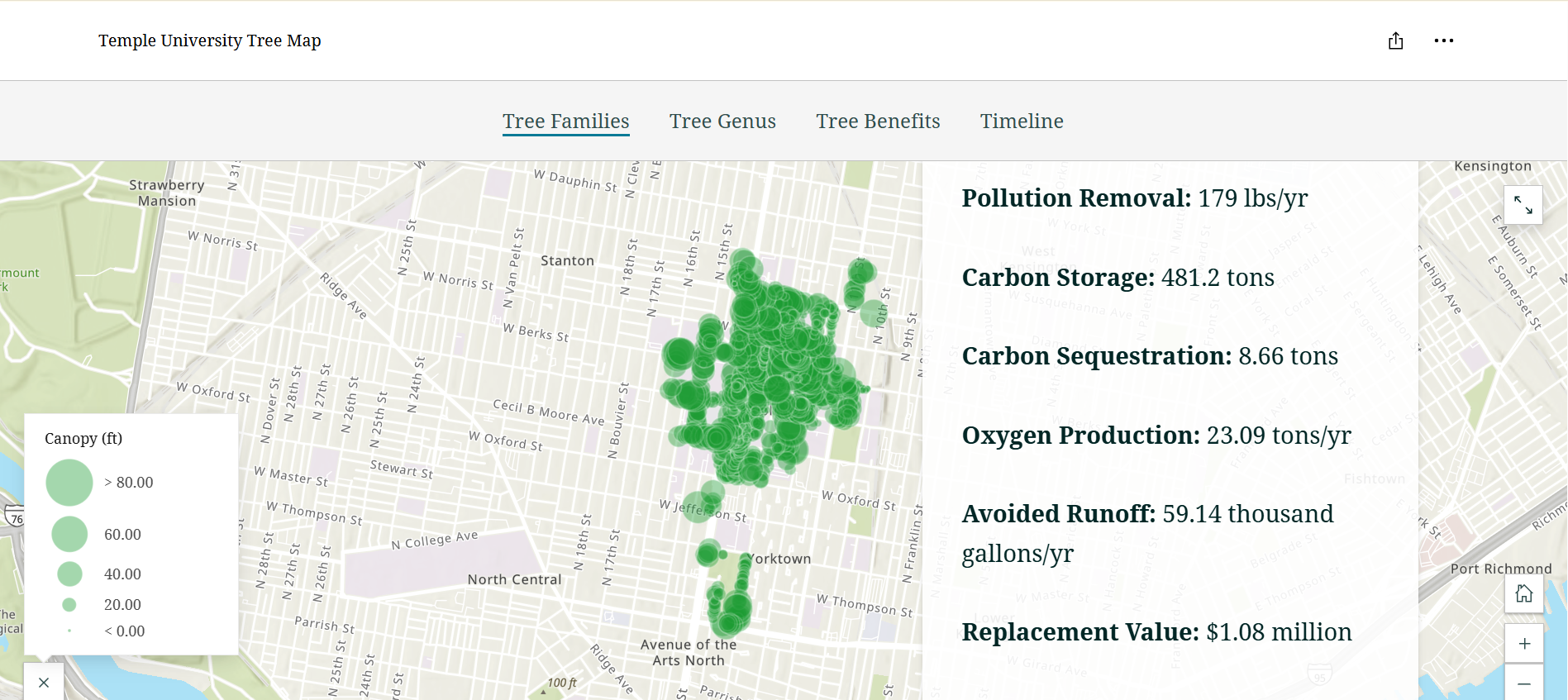
According to Temple University’s 2025 Main Campus Tree Inventory, the campus trees are estimated to store nearly 482 tons of carbon, remove 179 pounds of air pollution and help prevent more than 59,000 gallons of stormwater runoff annually.
Red Maple (Acer rubrum)
The red maple is a native deciduous tree across eastern North America, known for its red fall foliage that brings a vibrant seasonal color to Main Campus in the autumn. The red maple trees by the loading docks of Beury Hall and the Biology-Life Sciences Building were planted in the 1990s. Red maples attract invasive spotted lanternflies, which feed on the tree’s sap and secrete a sticky, sugary waste liquid known as honeydew. It is another native tree found in floodplain environments, where water spreads out and inundates it for days at a time, adapting well to flooded conditions.
Japanese white pine (Pinus parviflora)
Three Japanese white pine trees are planted in front of Tyler School of Art and Architecture, between the building and the main entrance accessible ramp. White pine tree needles grow in bundles of five and are generally less adaptable to urban conditions because they prefer cooler conditions and more nutrient-rich soil. Unlike native eastern white pines, which are also more susceptible to branch damage during heavy ice and snowstorms, Japanese white pines are somewhat better suited to withstand urban conditions.
Fort Mcnair red horse chestnut (Aesculus × carnea 'Fort McNair')
The trio of Fort McNair red horse chestnuts produces fuchsia-colored blooms each spring, creating a picturesque scene to take photos on Main Campus during Commencement. Located between the Tyler accessible ramp and the main entrance stairs, the Fort McNair red horse chestnut belongs to the genus Aesculus. It produces fruits and seeds, but they are toxic and inedible. This tree’s leaves are palmately compound, with a single bud producing one leaf, made up of several leaflets. As an example of a hybrid tree on Main Campus, the Fort McNair is a cross between the North American native red buckeye, known for its smaller stature, and the European horse chestnut, a much larger tree with white flowers. This cross is believed to have originated in Germany and shows how plants from different parts of the world can be hybridized to create new varieties.
Tree of 40 Fruit
The Tree of 40 Fruit is a single grafted tree that produces 40 different varieties of peaches, cherries, apricots, plums and other stone fruits. Artist Sam Van Aken carefully selected and grafted 40 compatible Prunus varieties onto the tree and planted it in the central greenspace courtyard of Tyler in March 2025. The horticultural technique he used dates back to around 1800 B.C. It involves attaching part of one plant to another so they grow together as one, sharing resources while each produces its own unique fruit. Van Aken made an angled cut into two components: the rootstock and a scion—the young shoot from another plant—and fused them together with grafting wax and tape. After a couple of weeks, everything knits and the bud starts to grow. When flowers of different varieties cross-pollinate, they tend to produce a greater harvest.
Valley forge elm (Ulmus americana 'Valley Forge')
The Valley Forge American elm, once a widely planted native tree, now lines the Science Education and Research Center sidewalk along 12th Street. The Valley Forge American elm is a disease-resistant variety known for its tenacity and ability to withstand difficult conditions. It was named in honor of George Washington’s troops and their resilience during the harsh winter of 1777–1778 at Valley Forge. The American elm’s longevity and expansive, umbrellalike canopy of foliage make it an ideal street and park tree wherever shade is desired. In the forest, the trees support hundreds of other organisms. The introduction of Dutch elm disease from Europe in the 1930s, followed by its spread over subsequent decades, caused most American elm trees to die. Eventually, the few trees that remained offered the opportunity to collect cuttings from these disease-resistant individuals for further evaluation and propagation. These and other resistant varieties are now allowing new plantings of this important native species to be reestablished.
Learn more about participating in volunteer opportunities, events and programs with the Office of Sustainability, and follow Sustainability and their partners on Instagram: @tusustainability, @phillytreecoalition, @phsgardening.
Temple’s campus tree mapping and interactive StoryMaps can be explored online through the Tree Inventory Map (Main Campus), Temple Health Sciences Center Sustainable Campus Map and the Office of Sustainability website.
 Built with Shorthand